



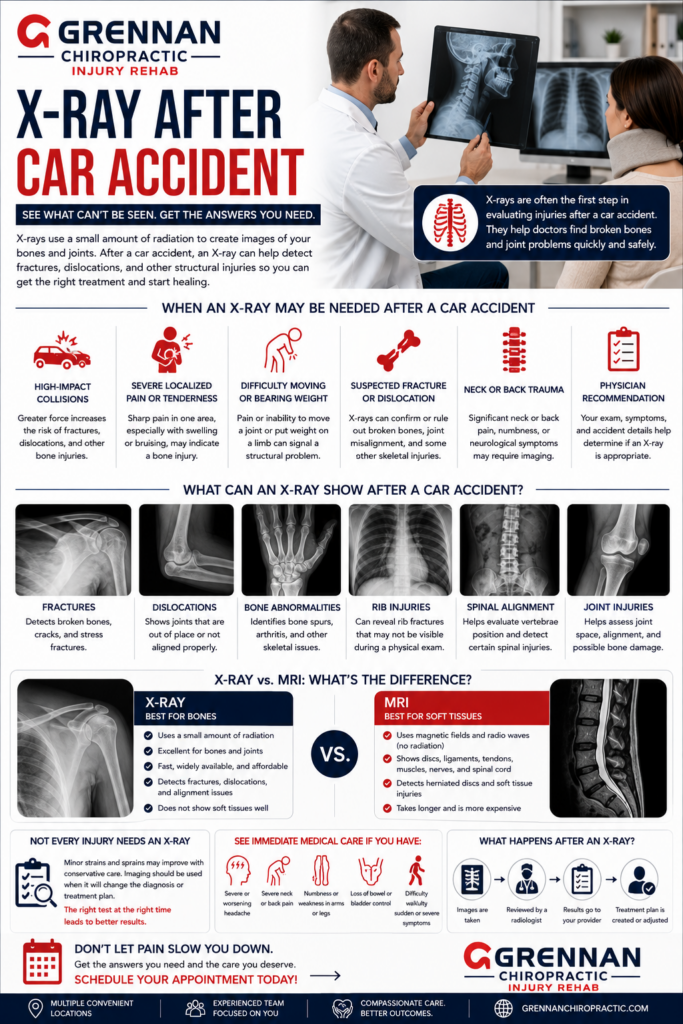
After a car accident, pain can develop in the neck, back, shoulders, ribs, arms, legs, and other areas of the body. Some injuries are relatively easy to identify during a physical examination. Others may require diagnostic imaging to determine whether the collision caused a fracture, dislocation, or another structural problem.
An X-ray after a car accident is one of the most common imaging tests used when healthcare providers need to examine bones and joints. X-rays can help identify many fractures and dislocations while providing additional information about skeletal structures in an injured area.
However, not every accident patient needs an X-ray.
At Grennan Injury Rehab, patients are evaluated for musculoskeletal injuries following automobile collisions. Whether diagnostic imaging is appropriate depends on the accident, symptoms, examination findings, and potential warning signs.
The objective is not to order as many tests as possible. Imaging should help answer a specific question about the injury and guide the next step in care.
Why Would You Need an X-Ray After a Car Accident?
X-rays are particularly useful when a healthcare provider needs to evaluate bones.
The technology uses a controlled amount of ionizing radiation to create images of structures inside the body. Dense structures such as bones absorb X-rays differently than surrounding soft tissues, allowing them to appear clearly on the resulting images.
The FDA’s medical X-ray imaging overview explains that X-ray imaging is used to diagnose and monitor a variety of medical conditions.
Following a collision, an X-ray may be considered when there is concern about:
- A fracture
- A dislocation
- Certain joint injuries
- Bone abnormalities
- Significant localized tenderness
- Certain spinal injuries
- Other skeletal trauma
The decision depends on the circumstances.
A relatively minor collision followed by mild muscle soreness presents a very different situation from a high-impact accident involving severe localized pain and difficulty moving.
Do You Always Need an X-Ray After a Car Accident?
No.
Being involved in a car accident does not automatically mean an X-ray is necessary.
Healthcare providers generally consider the mechanism of injury, symptoms, examination findings, age, medical history, and other factors when deciding whether imaging is appropriate.
The American College of Radiology Appropriateness Criteria provides evidence-based recommendations for medical professionals choosing imaging studies in different clinical situations.
For many musculoskeletal injuries, an examination may provide enough information to begin conservative treatment.
For other patients, imaging becomes important early in the process.
What Can an X-Ray Show After a Car Accident?
X-rays are especially valuable for evaluating skeletal structures.
Depending on the area being examined, an X-ray may help identify:
- Bone fractures
- Joint dislocations
- Certain alignment abnormalities
- Bone degeneration
- Some forms of joint damage
- Other skeletal abnormalities
For example, if a patient has substantial shoulder pain after striking the door during a side-impact collision, an X-ray may help evaluate whether a bone or joint injury occurred.
Similarly, significant localized pain following trauma may raise concern about a fracture.
However, X-rays cannot provide equally detailed information about every structure.
That limitation becomes important when symptoms suggest a soft-tissue injury.
What Doesn’t an X-Ray Show Well?
An X-ray provides far less detail about many soft tissues than an MRI.
That means a normal X-ray does not necessarily mean that an accident caused no injury.
Muscles, ligaments, tendons, spinal discs, nerves, and other soft tissues can be injured during a collision without producing an obvious abnormality on a conventional X-ray.
This is one reason someone can leave an emergency department after being told that their X-rays showed no fracture and still experience significant pain during the following days.
“No fracture” and “no injury” are not the same conclusion.
A patient may still have whiplash, muscle strains, joint injuries, or other musculoskeletal problems requiring evaluation and treatment.
X-Ray vs. MRI After a Car Accident
X-ray and MRI serve different purposes.
An X-ray is generally more useful for evaluating bones and many fractures.
MRI provides considerably greater detail of many soft tissues, including spinal discs, ligaments, tendons, muscles, the spinal cord, and other structures.
As explained in our guide to when you need an X-ray or MRI, neither test is universally better.
The appropriate test depends on what the provider needs to investigate.
A patient might have an X-ray first because a fracture needs to be ruled out. If significant neurological or soft-tissue symptoms continue, an MRI may later become appropriate.
The tests can therefore provide complementary rather than competing information.
X-Rays for Neck Pain After a Collision
Neck pain is extremely common following motor vehicle accidents.
Rear-end collisions can cause rapid acceleration and deceleration of the head and neck, resulting in whiplash.
Whiplash commonly affects soft tissues and joints throughout the cervical region. Patients may experience pain, stiffness, muscle tightness, headaches, and reduced range of motion.
An X-ray does not directly show every soft-tissue injury associated with whiplash.
However, imaging may be appropriate when providers need to evaluate potential fractures or other skeletal concerns.
Someone seeing a neck injury chiropractor should undergo an appropriate evaluation before treatment begins.
The provider can then determine whether symptoms and examination findings indicate that additional imaging or medical evaluation is necessary.
X-Rays for Back Pain After a Car Accident
Back pain following a collision can originate from several structures.
Muscles may be strained. Joints can become irritated. Discs may be injured. Nerves can become involved. Trauma can also cause fractures in certain circumstances.
X-rays can provide useful information about bones and skeletal structures, but they do not directly visualize spinal discs in the same way as MRI.
Someone working with a back injury chiropractor may therefore require different types of evaluation depending on their symptoms.
Localized pain following significant trauma may raise one set of concerns.
Pain that travels down a leg with numbness or tingling may raise another.
The imaging choice should reflect the suspected injury.
Can an X-Ray Show Whiplash?
An X-ray does not provide a simple positive or negative test for whiplash.
Whiplash is associated with rapid movement of the cervical spine and often involves soft tissues that are not clearly visualized on conventional X-rays.
However, X-rays may still be used when a provider needs to evaluate bones or rule out certain other injuries following neck trauma.
This distinction matters.
A normal X-ray does not automatically mean that a patient experiencing neck pain after an accident has no injury.
Someone receiving chiropractic care after a car accident may still require treatment for appropriate musculoskeletal injuries even when no fracture appears on an X-ray.
Can an X-Ray Show a Herniated Disc?
A standard X-ray cannot directly show a herniated disc the way an MRI can.
Spinal discs are soft-tissue structures positioned between the vertebrae.
An X-ray may show the bones around the disc and provide information about certain aspects of spinal structure, but it does not provide the detailed soft-tissue visualization available with MRI.
This becomes important when symptoms suggest disc or nerve involvement.
For example, someone with lower back pain may later develop:
- Shooting leg pain
- Numbness
- Tingling
- Burning sensations
- Weakness
These symptoms may require additional evaluation.
Depending on the clinical findings, an MRI after a car accident may provide more useful information about discs, nerves, and surrounding soft tissues.
What If Your X-Ray Is Normal but You Still Have Pain?
This is a common situation.
An accident patient visits an emergency department or urgent care center. X-rays are taken. No fracture or dislocation is found.
Yet several days later, the patient still has significant neck or back pain.
That does not necessarily mean something was missed on the X-ray.
It may mean the injury involves structures that X-rays are not designed to visualize in detail.
Muscle strains, ligament injuries, joint problems, and certain disc injuries may continue producing symptoms even when an X-ray appears relatively normal.
This is why follow-up evaluation can matter.
A physical examination can help determine whether conservative rehabilitation is appropriate or whether persistent symptoms justify additional investigation.
Delayed Pain After an Accident
Not every injury is immediately obvious at the scene of a crash.
During the hours following an accident, pain and stiffness may become increasingly noticeable.
Someone who initially felt relatively comfortable may wake the following morning with substantial neck stiffness or lower back pain.
New symptoms should be evaluated based on their characteristics rather than dismissed simply because they did not appear immediately.
For example, localized soreness is different from progressive numbness or weakness.
If symptoms change, the evaluation and treatment plan may also need to change.
Numbness or Tingling May Require More Than an X-Ray
Neurological symptoms deserve particular attention.
Numbness, tingling, burning, shooting pain, or unexplained weakness may indicate nerve involvement.
An X-ray may provide useful information about surrounding skeletal structures, but it generally cannot provide the same detailed view of discs, nerves, and other soft tissues as MRI.
Depending on the symptoms, a provider may recommend additional imaging or specialist evaluation.
Someone experiencing neurological symptoms should describe exactly where they occur and whether they are improving, worsening, or spreading.
These details can help determine what should happen next.
X-Rays After High-Impact Accidents
The mechanism of an accident can influence imaging decisions.
A minor parking-lot collision does not expose the body to the same forces as a high-speed highway crash.
More substantial trauma can increase concern about fractures and other significant injuries.
Providers may consider factors such as:
- Vehicle speed
- Direction of impact
- Vehicle damage
- Whether airbags deployed
- Where the occupant was seated
- Whether the patient struck part of the vehicle
- Current symptoms
- Physical examination findings
No single factor automatically determines whether an X-ray is required.
Instead, healthcare professionals consider the complete situation.
Is It Safe to Get an X-Ray?
Medical X-rays use ionizing radiation.
However, healthcare professionals use imaging when the expected diagnostic benefit outweighs the potential radiation risk.
The amount of radiation depends on the specific examination and body area.
Patients should tell their healthcare provider or imaging technician if they are pregnant or believe they may be pregnant before undergoing an X-ray.
Medical professionals can then determine the appropriate next step.
MRI differs because it does not use ionizing radiation, although MRI has its own safety considerations involving strong magnetic fields and certain implants or devices.
What Happens During an X-Ray?
X-ray examinations are generally quick.
The technologist positions the patient and the body area being examined so the necessary images can be obtained.
Several images may be taken from different angles.
Remaining still during the exposure helps produce a clear image.
The X-ray itself does not cause pain. However, positioning an already injured neck, shoulder, back, or extremity can sometimes be uncomfortable.
Afterward, the images are interpreted by an appropriately qualified healthcare professional, often a radiologist.
What Happens if the X-Ray Finds an Injury?
The next step depends on what the imaging shows.
A fracture, dislocation, or another significant finding may require referral to an appropriate medical specialist.
Other findings may support conservative care.
Treatment could involve:
- Immobilization when appropriate
- Orthopedic evaluation
- Additional imaging
- Physical rehabilitation
- Pain management
- Chiropractic treatment for appropriate conditions
- Other specialist care
An injury rehabilitation chiropractor can address appropriate musculoskeletal injuries when the evaluation supports conservative rehabilitation.
If imaging identifies a condition outside that scope, referral becomes important.
When Is an MRI Needed After an X-Ray?
An MRI is not automatically the next step after every normal X-ray.
However, it may become useful when significant symptoms remain unexplained or when soft-tissue or neurological involvement is suspected.
For example, additional evaluation may be considered when someone develops persistent:
- Radiating pain
- Numbness
- Tingling
- Weakness
- Significant neck or back pain
- Neurological changes
- Limited improvement despite treatment
An MRI can provide detailed information about many structures that an X-ray cannot show clearly.
Again, imaging should be selected based on what providers need to investigate.
When Symptoms Need Immediate Medical Attention
Some symptoms following a car accident should not wait for a routine imaging or chiropractic appointment.
Prompt medical evaluation may be necessary for severe trauma or symptoms such as:
- Significant or worsening weakness
- Loss of sensation
- Loss of bowel or bladder control
- Difficulty walking
- Severe or rapidly worsening pain
- Major neurological changes
- Significant head-injury symptoms
- Difficulty breathing
Emergency symptoms require an appropriate level of medical care.
Routine outpatient X-rays should not delay emergency evaluation when serious injuries are possible.
Frequently Asked Questions About X-Rays After Car Accidents
Should I get an X-ray after a car accident?
Not everyone needs one. An X-ray may be appropriate when symptoms, examination findings, or the accident mechanism raise concern about fractures, dislocations, or other skeletal injuries.
How soon after a car accident should you get an X-ray?
An X-ray can be obtained immediately when medically appropriate. There is no required waiting period.
Can an X-ray show injuries from a car accident?
Yes. X-rays can identify many fractures, dislocations, and other skeletal abnormalities. They are less effective for evaluating many soft-tissue injuries.
Can an X-ray show whiplash?
X-rays do not directly show every soft-tissue injury associated with whiplash. They may still be useful for evaluating bones and ruling out certain injuries after neck trauma.
Can an X-ray show a pinched nerve?
Not directly. An X-ray may provide information about skeletal structures, but MRI and other testing may provide more information when nerve involvement is suspected.
Why am I still hurting if my X-rays were normal?
A normal X-ray can rule out certain problems without ruling out every injury. Muscles, ligaments, discs, joints, and other soft tissues can still be injured.
Is an MRI better than an X-ray after a car accident?
Neither is universally better. X-rays are particularly useful for bones, while MRI provides greater detail of many soft tissues.
Can you need both an X-ray and MRI after an accident?
Yes. The tests provide different information, so some patients may require both depending on their injuries and symptoms.
The Right Imaging Depends on the Injury
An X-ray after a car accident can provide important information when healthcare providers are concerned about fractures, dislocations, or other skeletal injuries.
However, an X-ray is only one part of an injury evaluation.
A normal result does not automatically rule out whiplash, muscle strains, ligament injuries, disc problems, or other soft-tissue conditions. Persistent pain or neurological symptoms may require further examination and, in some situations, additional imaging such as MRI.
Grennan Injury Rehab evaluates musculoskeletal injuries following car accidents and helps patients determine an appropriate path toward recovery. When diagnostic imaging or another specialist is necessary, that information can be incorporated into the broader treatment plan.
If neck pain, back pain, stiffness, reduced movement, or other musculoskeletal symptoms continue following a collision, schedule an appointment with Grennan Injury Rehab to have the injury evaluated and determine whether additional diagnostic care may be appropriate.